|


 |
Excerpt from Urban Myths: Aboriginal Artists in the City Catalogue
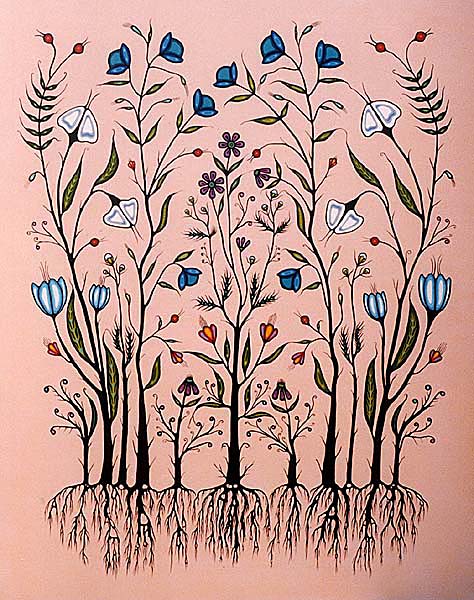
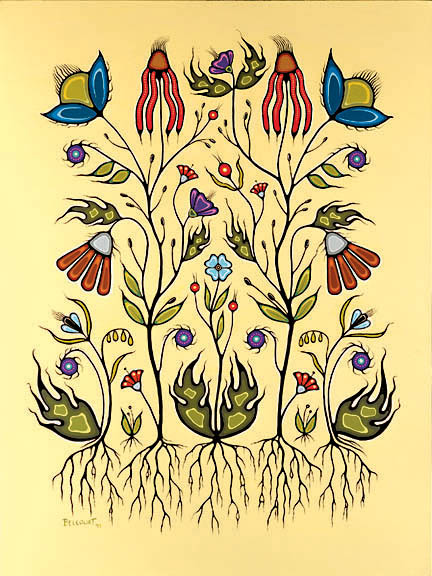
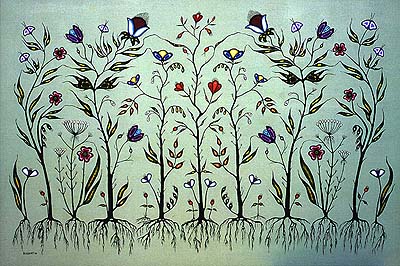
“The decision to include Métis painter Christi Belcourt in Urban Myths marked a threshold in the evolution of our thinking about the exhibition. We had expected naively to find a group of artists whose works depicted, or commented directly on, life in the metropolis. Belcourt is an artist who creates gorgeous, exacting paintings of flowers, painted in jewel-like colours on monochrome pastel grounds. It seemed, at first take, that her graceful images had little to say about the contemporary urban life. Belcourt gently opened my mind in a compelling e-mail discussing her ideas of home/land and identity. Her father’s family is from the Métis community of Lac St. Anne in Alberta, but few Métis reside there today. She feels strong ties to the West, but has never lived there. So where is home? Not Ottawa, Belcourt avers, although she was raised there. She asks, how does a person of Aboriginal ancestry such as myself, born and raised in an urban environment, without a tangible connection to a community they can call home, still continue to have influences within their work which are clearly Aboriginal…? This is the fundamental, admittedly unanswerable, question at the heart of Belcourt’s artistic practice. The three floral paintings Belcourt showed in Urban Myths share a common style, subject, and composition. A skeletal row of roots arrayed across the bottom of the canvas anchors curvilinear stems that stretch upward; vivid, delicate blossoms are everywhere in profusion. Each flower is delineated finely in black and rendered in a schematic manner reminiscent of classic Woodland School painting. The paintings posses a smooth, stylized elegance, each presents an exquisite bouquet, a paean to the botanical world. Like generations of Métis and First Nations women beadworkers and quillworkers before her. Belcourt celebrates the beauty of the flowers while exploring their symbolic properties. The blue flower in the centre of Resilience of the Flower Beadwork People, for example, represents the Métis; the many variegated blooms surrounding it symbolize the Métis’ ethnic diversity – Cree, French, Irish, Ojibway, etc. Belcourt sees Ottawa as having a “shared national Aboriginal community,” because Aboriginal people from across Canada live there. The different blossoms in Community reflect this diverse body of people who, she writes, “interact, who share, who belong, and who contribute to the whole.” It is significant that Belcourt leaves the roots of her plants hanging exposed. The Métis unlike many First Nations and Inuit peoples in Canada, do not have a land base they can call home. “Home” is thus founded on the pride of being Métis and on the identifying with the Métis Nation across Canada. The roots, though bare, are entwined and tenacious, and the blossoms are at the peak of their splendour. As Belcourt says, the Métis are “resilient as a weed. And beautiful as a wildflower.” For Belcourt, painting, then, is a way of clarifying identity – individual and cultural – and building community.”
Community in June, Acrylic on Canvas, 60" x 90"
|
|